With formulas scaled and ingredients understood, this module covers the physical execution phases. The transition from shaggy mass to structured loaf requires specific kinetic interventions scheduled around biological activity.
2.1 The Autolyse Phase
A technique popularized by Raymond Calvel, the true autolyse involves mixing only flour and water, leaving it to rest for 30 minutes to several hours before adding salt or yeast/levain. During this phase:
- Hydration: Starch and proteins fully absorb water.
- Enzymatic Action: Protease enzymes begin degrading gluten bonds slightly, increasing extensibility (stretchiness). Amylase converts complex starches into simple sugars for the yeast to consume later.
- Result: Dough that is easier to handle, requires less mechanical kneading, and achieves superior flavor complexity.
2.2 Bulk Fermentation and Structural Folds
Once the inoculant (yeast/levain) and salt are integrated, Bulk Fermentation begins. This is the primary period of gas production and flavor development. Instead of violent, continuous kneading, modern artisan methods utilize periodic folds.
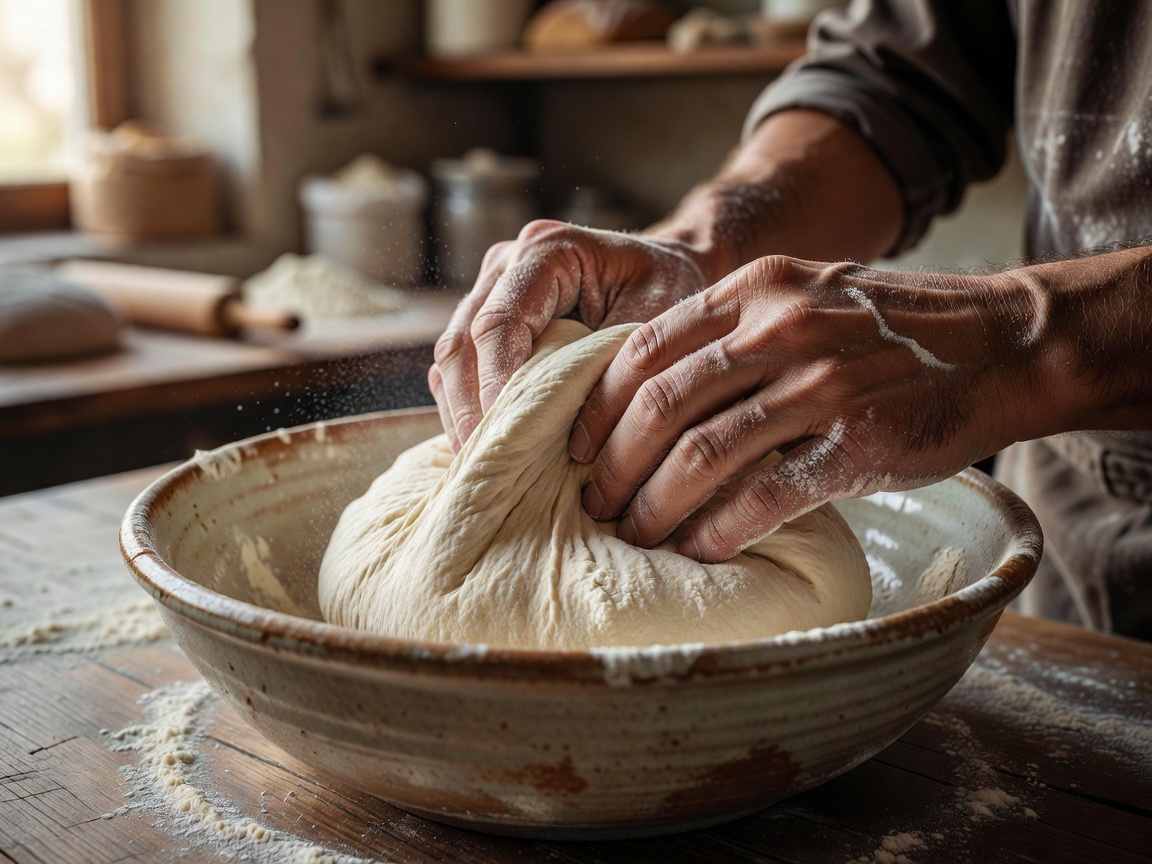
Stretch and Fold / Coil Folds: Executed every 30 to 45 minutes during the early stages of bulk fermentation. This action aligns gluten strands, adding structural tension, while equalizing dough temperature and redistributing the yeast colony's food source.
Identifying the end of bulk fermentation is an acquired skill. The dough should display a 30% to 50% volume increase, exhibit domed edges, and contain visible internal gas pockets.
2.3 Shaping and the Proof
Shaping is not merely aesthetic; it establishes an external skin of tension that forces expanding gases to push upward (oven spring) rather than outward (pancaking). Common shapes include the round Boule and the oblong Bâtard, traditionally supported during proofing in a woven basket known as a Banneton.
2.4 Thermal Management: The Bake
Baking is a sequence of thermal events:
- Steam and Spring (Minutes 0-20): Bread is loaded into a preheated environment (like a sealed Dutch Oven). Steam delays crust formation, allowing maximum expansion. The rapid expansion of trapped gas is termed "Oven Spring."
- The Maillard Reaction (Minutes 20-40): Once steam is vented, the crust dries. Amino acids and reducing sugars react under high heat to create complex flavor compounds and deep brown coloration. Pale bread lacks flavor depth.